Phoenix
A Bird That Only Comes When It Is Safe
On houou, and what it means to carry the image of something that refuses to exist in difficult times
You already know the Western phoenix. It burns. It dies. It rises from its own ashes — solitary, cyclical, defined entirely by its relationship with destruction. It is a beautiful idea, and a consoling one. Suffering as preparation. Ruin as prologue.
The Japanese houou does not burn.
It is said to appear only when the world is at peace — descending from the heavens in times of virtue and harmony, nesting in paulownia trees, eating nothing but bamboo seed, harming nothing. When it flies, the wind grows still, the dust settles, and every other bird falls silent. It does not herald its own rebirth. It heralds the goodness of the age it has chosen to enter.
The Western phoenix survives catastrophe. The Japanese hoo declines to participate in it.
This is a different relationship with difficulty entirely. Not transformation through suffering, but a kind of sovereign refusal. The hoo does not endure. It selects. It arrives when conditions are worthy of it, and its arrival is itself a sign that they are.
For a Western reader, this may initially feel passive. But sit with it longer. There is a discipline in this, and a discernment. The hoo does not lower itself. It maintains, across centuries of absence if necessary, a standard. It knows what it is worth, and it will not appear for less.
The hoo arrived in Japan from China during the Asuka period, carrying with it the full weight of imperial symbolism. It became associated particularly with the Empress. Its body, according to classical description, is assembled from many creatures: the beak of a rooster, the neck of a snake, the breast of a crane, the back of a tortoise, the tail of a fish. It is a composite of the best parts of everything, arranged into something that transcends each of them.
There is no houou in nature to get wrong. Every rendering is already an interpretation, already an act of faith.
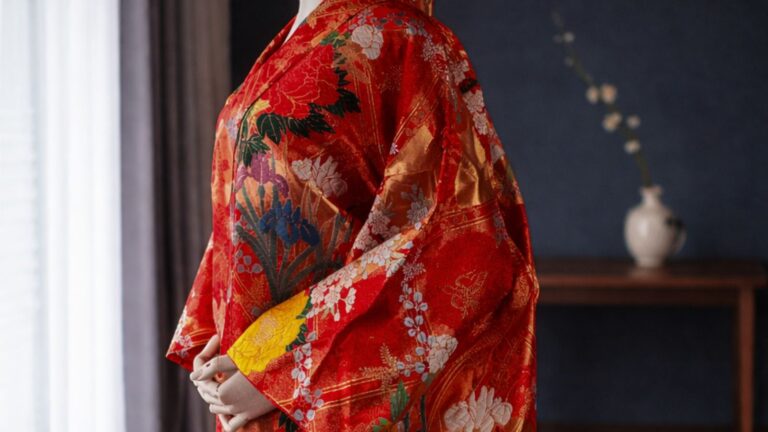
On formal obi and ceremonial uchikake, houou compositions tend toward a particular quality: amplitude without agitation. The bird is often shown in full flight — wings spread, tail streaming — but there is no urgency in the movement.
The houou is frequently paired with paulownia — the tree it is said to nest in — or with flowing clouds and flames. The flames are not destruction; they are the visible edge of the sacred, the point where the ordinary world ends and the bird’s world begins.
To wear a hoo motif is to make a particular kind of statement. It is not a wish for survival. It is a claim about the quality of the moment being inhabited. That this day, this occasion, this life deserves the presence of something that only comes for the best of times.
The bird that refuses difficult times is not escapist. It is, in its way, the most demanding of motifs. It asks the wearer to agree: that the garment, and the moment it marks, are worthy of a creature that has been waiting, somewhere above the clouds, for exactly this.
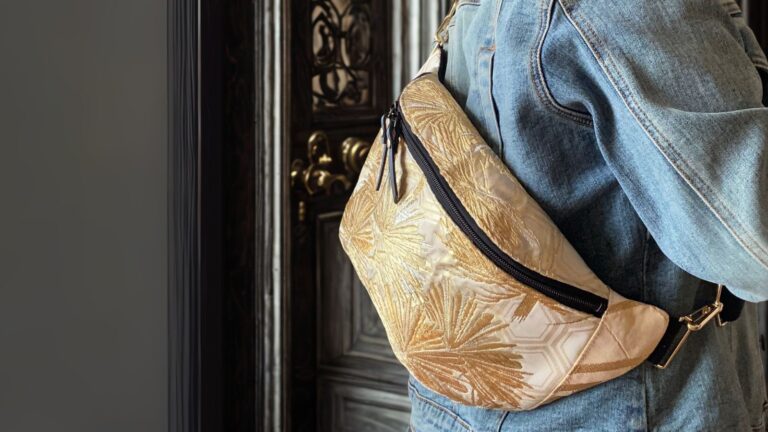
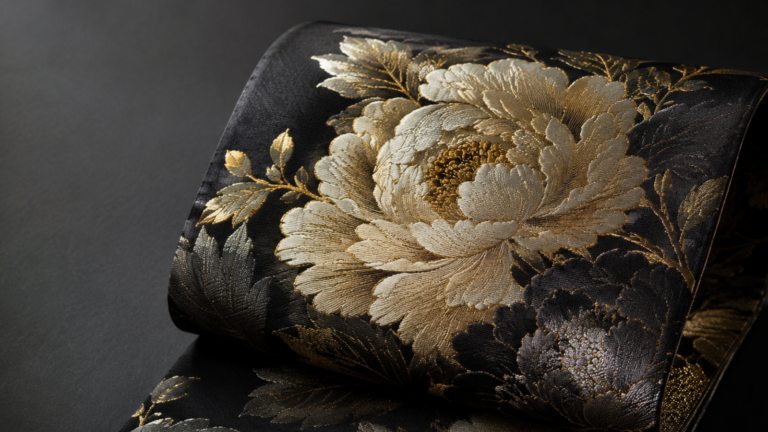
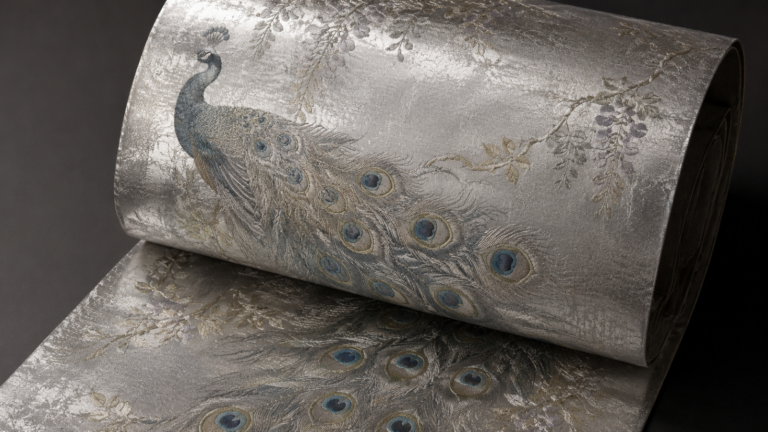
Houou motifs appear across miyakorondo obi pieces — often in compositions where the bird moves through paulownia and cloud, its tail trailing off the edge of the cloth as if it has just arrived, or is just departing.