Peony
A Foreign Flower, Perfectly at Home
On botan, and what it means that Japan’s most opulent motif was never Japanese to begin with
Japanese aesthetics are often described in terms of what they leave out. The unfinished edge. The empty corner. The pause between notes. Wabi, sabi, ma — a whole vocabulary built around absence, restraint, the beauty of the incomplete.
And then there is the peony.
Botan does not leave anything out. Its petals accumulate in layers so generous they seem almost architectural — each bloom a small palace of silk, folding inward and outward simultaneously. There is nothing restrained about it. Nothing unfinished. It is, by any measure, too much.
And yet it appears on the most formally significant textiles in Japan. On ceremonial obi and uchikake. Alongside phoenixes and lions. In the hands of master weavers who could have chosen anything, and chose this.
The question is not why the peony succeeded in Japan. The question is what Japan saw in it that made restraint, for once, seem beside the point.
Botan arrived from China, where it had long been called the “king of flowers” — a title earned not through delicacy but through dominance. Japan encountered this flower and this idea simultaneously. But something happened in translation. The Chinese botan was about power openly displayed. The Japanese botan became something subtler: abundance earned, opulence with composure.
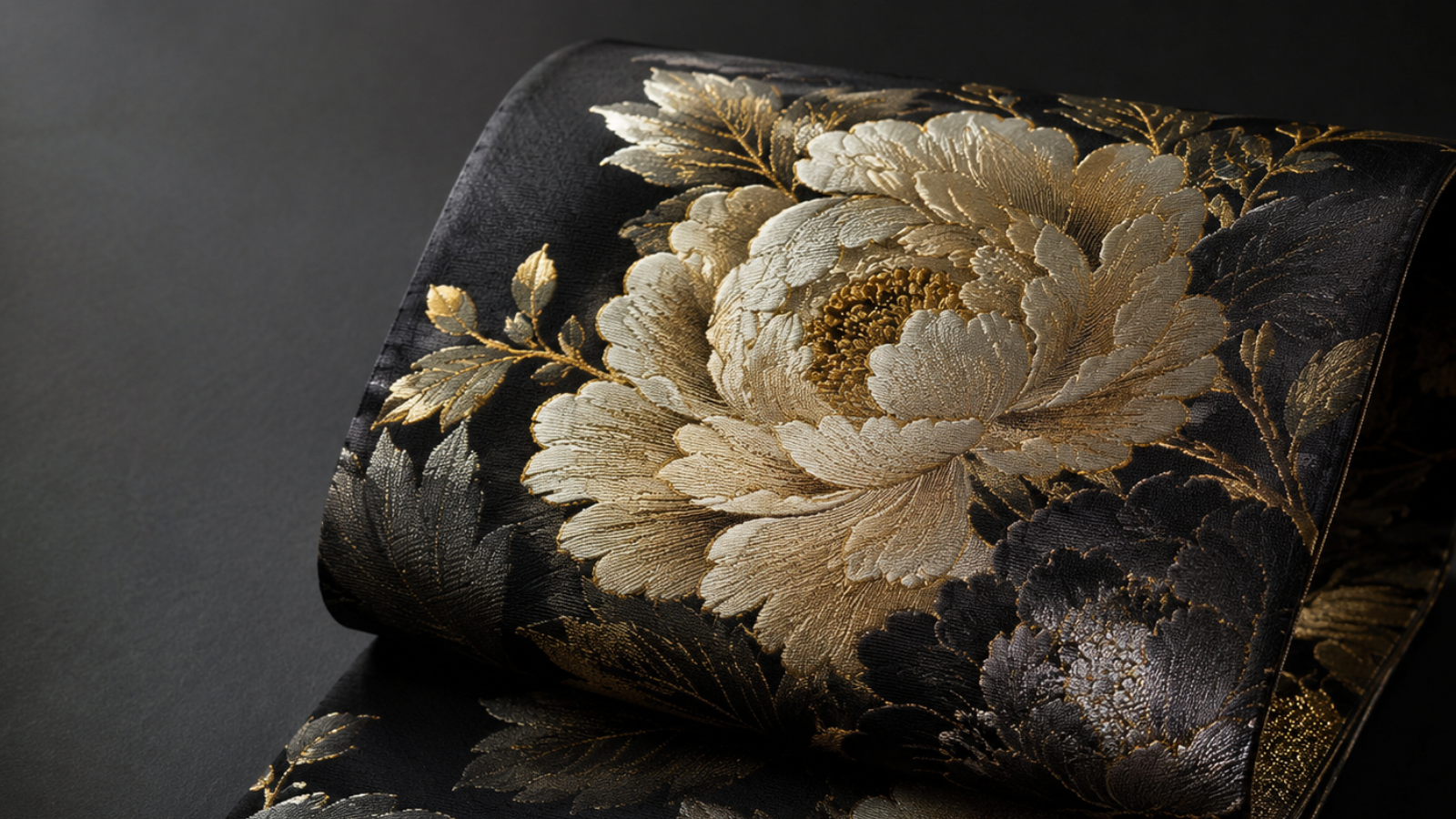
On formal obi, botan is often woven or embroidered at a scale that would overwhelm a lesser textile. The craftsmanship required to achieve this is itself a kind of argument: that such effort, spent on such abundance, is not excess. It is devotion.
The peony in Japanese textile design frequently appears with the karajishi — the Chinese lion, a mythological creature that lives among peonies and draws strength from their fragrance. Abundance and power are not opposites here; they are companions, each making the other legible.
Perhaps this is what Japan understood: that some beauties do not require emptiness to justify them. That fullness, rendered with enough care, becomes its own form of precision.
There is also a seasonal dimension. Botan belongs to late spring — a moment of peak warmth before the slow turn toward summer’s heat. The peony’s extravagance is not permanent extravagance. It is the extravagance of something that knows its time is short.
A peony on silk is not decoration. It is a declaration: that beauty at its fullest is worth the making, worth the wearing, worth the keeping.
To hold a piece of obi with a botan composition is to feel this. The weight of the weave. The depth of the color. The way the petals seem to move even when the cloth is still. It came from somewhere else, this flower. It traveled a long way, and changed along the journey. But it arrived, and it stayed, and now it is impossible to imagine Japanese textile culture without it.
Some things become native not through origin, but through belonging.
Botan motifs appear in several miyakorondo obi pieces — most often in formal black obi where the peony composition emerges from a deep ground, quiet until the light shifts.