
Paulownia
The Crest That Was Given, Not Chosen
On kiri, and what it means to carry a symbol that has always belonged to someone greater than yourself
The other motifs in this series were chosen for their beauty, their symbolism, their poetic resonance with the natural world. The crane for longevity. The peony for abundance. The plum for resilience. Each arrived on silk because someone found it beautiful, or meaningful, or both.
The paulownia is different. Kiri did not earn its place on textile through beauty alone. It earned it through authority — through centuries of being the mark that the most powerful people in Japan either held, coveted, or carefully declined.
To understand kiri is to understand that in Japan, a symbol can accumulate so much history that its presence on cloth becomes an act of positioning — a statement about where one stands in relation to power itself.
The paulownia crest — kiri-mon — began as an imperial symbol, used on the Emperor’s robes as early as the Heian period. Over time, the Emperor began granting the paulownia crest to warriors and court nobles who had distinguished themselves. To receive the kiri-mon was to receive a piece of imperial authority, pressed into silk and lacquer. It was among the highest honors the court could give.
No one understood this better than Toyotomi Hideyoshi. Born into poverty, risen through military genius to become the most powerful man in sixteenth-century Japan, he adopted the paulownia as his family crest with a kind of fierce deliberateness — and then distributed it with extraordinary generosity to loyal retainers, using it as the Emperor had once used it: as a transferable token of recognized authority.
After his death, when Tokugawa Ieyasu finally unified the country under his own rule, he was offered the paulownia crest. He declined. This was not a modest gesture. It was a precise calculation: to reject a symbol at the height of your power is itself a demonstration of power.
The paulownia passed from the Toyotomi to the Meiji government, and eventually to the Cabinet and Prime Minister of modern Japan. The chrysanthemum stayed with the Emperor. Between them, these two crests divide the authority of the Japanese state.
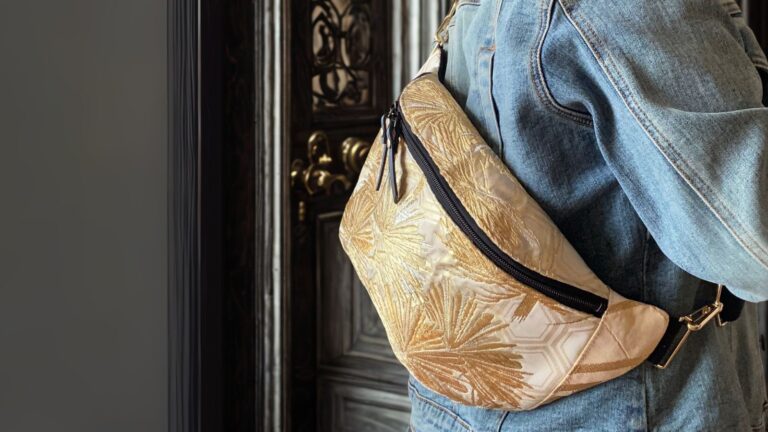
On obi and formal kimono, kiri appears differently from the way it circulates in political history. Here, the three-leafed branch with its cluster of stylized blossoms carries its weight quietly. It does not announce itself. It tends toward structure: clean lines, geometric precision, a form that reads as much as an emblem as an image of a plant.
There is also the tree itself — the actual paulownia that grows in Japanese gardens, bearing enormous leaves and fragrant violet flowers each spring. It is, by any measure, a generous tree. A daughter’s trousseau was sometimes packed in paulownia-wood drawers. The tree that symbolized imperial authority also furnished the domestic life of ordinary families.
To find kiri on a piece of textile is to find all of this compressed into a single emblem: imperial origin, transferred authority, the generous tree, the chosen branch. Not beautiful in the way that flowers are beautiful. Beautiful in the way that things with long histories become beautiful — through the accumulation of everything they have meant, to everyone who has touched them.
Kiri motifs appear in miyakorondo obi pieces most often in formal compositions — sometimes as a primary design, sometimes woven quietly into a ground that reveals itself only in certain light.