Chrysanthemums: The Flower of Nobility and Eternal Light
Introduction
Among the many floral motifs that appear in Japanese textiles, the chrysanthemum holds a unique and elevated place.
It is not merely a flower—it is a symbol of refinement, longevity, and imperial authority.
Unlike blossoms that express fleeting beauty or seasonal transition, the chrysanthemum represents something more enduring.
Its layered petals unfold with quiet precision, suggesting order, dignity, and an almost meditative stillness.
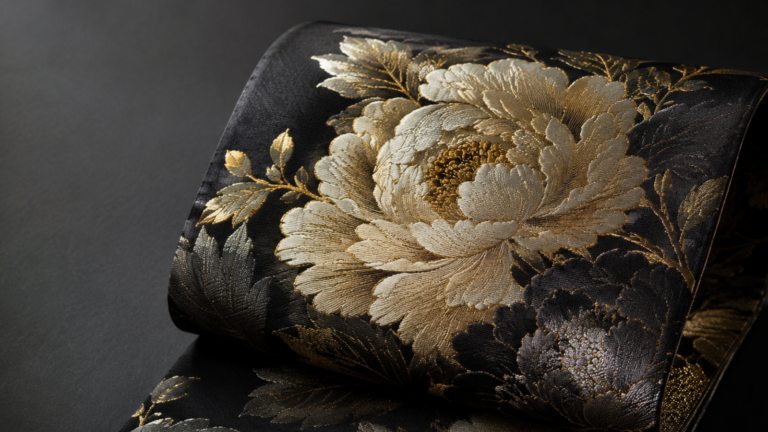
In kimono and obi, chrysanthemum motifs often appear composed and symmetrical, radiating outward like the sun.
They do not seek attention through extravagance, but rather through balance and presence.
To understand the chrysanthemum is to understand a fundamental aspect of Japanese aesthetics—
the appreciation of beauty that is structured, restrained, and timeless.
Origins
The chrysanthemum was originally introduced to Japan from China during the Nara and Heian periods.
In Chinese culture, it was already revered as one of the “Four Gentlemen” in classical painting, symbolizing integrity and resilience.
In Japan, however, the flower took on an even deeper significance.
By the Kamakura period, the chrysanthemum had become closely associated with the imperial family.
The sixteen-petaled chrysanthemum crest, known as the Imperial Seal of Japan, came to represent the Emperor himself.
This connection elevated the flower beyond seasonal decoration.
It became a visual language of authority, purity, and continuity.
Over time, chrysanthemum motifs spread into aristocratic garments, ceremonial textiles, and eventually into broader decorative arts.
Yet even as it became more widely used, it never lost its association with elegance and formality.
Japanese Interpretation
In Japanese design, the chrysanthemum is rarely depicted as a naturalistic flower.
Instead, it is stylized into precise, repeating forms.
Petals are arranged in radiating symmetry, often forming circular patterns that resemble the sun.
This transformation reflects a key aspect of Japanese aesthetics—the movement from nature to abstraction.
The chrysanthemum becomes less about a specific flower and more about a concept:
order, harmony, and controlled beauty.
Different variations exist, from simple outlines to highly intricate multi-layered designs.
Some emphasize geometric clarity, while others highlight softness through curved petals.
In all forms, however, the motif maintains a sense of balance and dignity.
Symbolism
The chrysanthemum carries a rich and layered symbolism in Japanese culture:
- Longevity and vitality
- Nobility and refined character
- Purity and clarity
- The continuity of life
- Solar energy and life force
Unlike flowers that symbolize brief beauty, the chrysanthemum represents endurance.
It blooms in the cooler months, standing resilient as other flowers fade.
This quality gives it a quiet strength—
a beauty that does not depend on fragility, but on persistence.
In ceremonial contexts, it also signifies respect and honor.
Its presence elevates the atmosphere, lending a sense of solemn elegance.
Seasonal Context
Chrysanthemums are strongly associated with autumn in Japan.
They bloom from late September through November, marking the deepening of the season.
The Chrysanthemum Festival, or Kiku Matsuri, celebrates their beauty through elaborate displays.
Flowers are carefully cultivated into large, sculptural forms, reflecting both natural beauty and human artistry.
In kimono, chrysanthemum motifs are most appropriate for autumn wear.
However, due to their formal and auspicious nature, they can also appear in garments worn year-round.
Their seasonal identity is therefore balanced by their symbolic importance.
Usage in Kimono
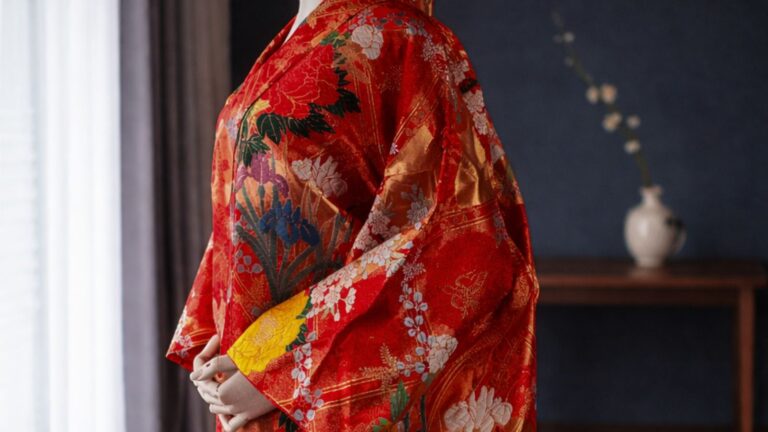
Chrysanthemum motifs are widely used in formal kimono and obi.
They often appear in gold thread or subtle tonal variations, enhancing their sense of refinement.
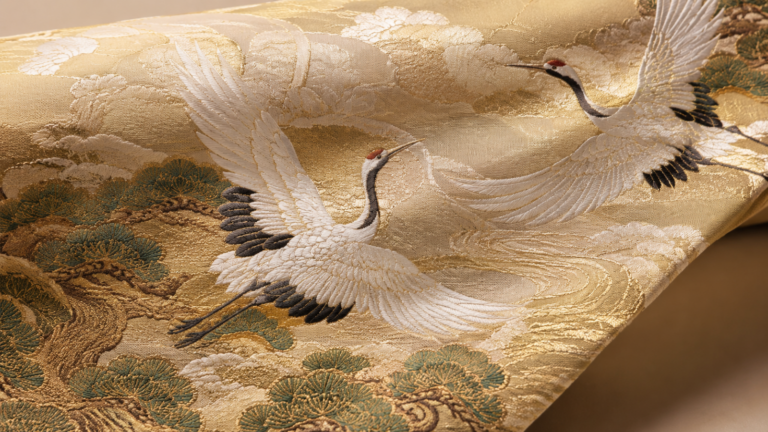
In black tomesode, they may be combined with other auspicious motifs such as cranes or flowing water.
In more contemporary designs, they can appear in simplified or monochrome forms.
Because of their association with nobility, chrysanthemum patterns are particularly suited for formal occasions.
Yet their versatility allows them to adapt to modern aesthetics as well.
Whether richly detailed or quietly minimal, the chrysanthemum maintains its presence.
Closing
The chrysanthemum does not overwhelm with color or movement.
Its beauty lies in its structure, its repetition, and its quiet radiance.
It is a flower that teaches us to see elegance not in excess, but in restraint.
Not in fleeting moments, but in enduring presence.
In the world of kimono, the chrysanthemum remains a symbol of timeless grace—
a reminder that true beauty is often found in what endures.