Plum Blossom
The Flower That Bloomed Before Anyone Was Watching
On ume, and what it means to be first — not triumphantly, but quietly, alone in the cold
There was a time, before the cherry blossom took everything, when the plum was the flower. Not one flower among many — the flower. In the Nara period, to say “hana” — flower — was to mean ume. Nothing else needed saying.
Then the Heian court turned its attention to sakura, and everything shifted. Ume did not fall so dramatically. It bloomed earlier, lasted longer, smelled stronger, and asked less of the viewer. Gradually, it stepped aside.
And yet ume did not disappear. It simply continued doing what it had always done: opening in the cold, before the audience arrived, without waiting to be invited.
Sakura blooms when the world is ready for it. Ume blooms in February, sometimes January, sometimes into the last hours of frost. The ume does not seem to notice. It opens anyway, fully, with a fragrance that carries further than any spring flower should have a right to, in weather that does not yet deserve it.
There is something more active in it. Not simply endurance, but insistence. The plum does not survive the cold. It chooses the cold as its moment.
There is a legend attached to ume. Sugawara no Michizane was a scholar and court official of the ninth century — brilliant, beloved, and eventually destroyed by political rivals who had him exiled. Before he left, he said farewell to his garden, and to his favorite plum tree in particular.
According to legend, the tree could not bear the separation. It uprooted itself and flew — across the sea, across the mountains — to be near him. The tobiume: the flying plum. When Michizane died, he was eventually enshrined as Tenjin, the god of learning. And ume became his symbol.
Of all the flowers that have accumulated meaning in Japanese culture, ume may be the one most associated with loyalty — not the loyalty of the powerful, but of the devoted.
On textile, the ume motif appears with a particular intimacy. A sprig of plum on a winter obi, a few blossoms and buds against a dark ground, suggests the moment just before spring without quite declaring it.
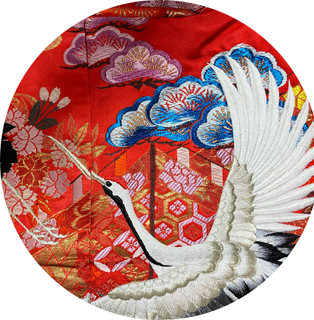
Ume belongs to the shochikubai — the Three Friends of Winter — alongside pine and bamboo. In formal compositions on obi and kimono, the three often appear together, their individual qualities reinforcing one another into a vocabulary of resilience.
To choose ume as a motif is to choose a different kind of beauty than sakura offers. Not the beauty of the moment everyone is watching, but the beauty of the moment before. Not impermanence, but anticipation.
Sakura says: look at this, while it lasts. Ume says something quieter, and in some ways harder: begin anyway. Open now. The season will catch up with you eventually. But do not wait for it.
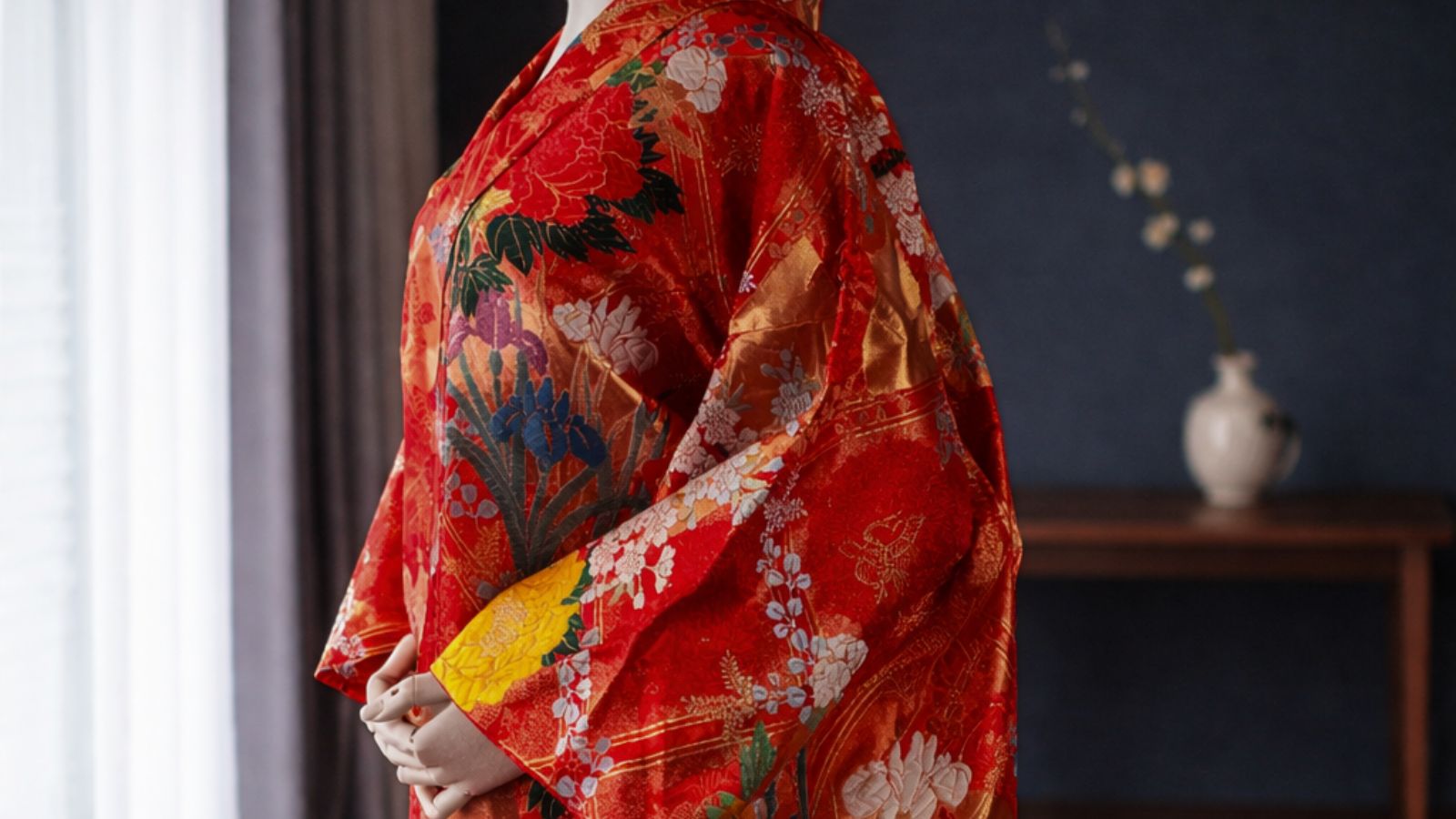
Ume motifs appear in miyakorondo pieces across several textile types — often in winter compositions, sometimes alongside pine or bamboo, occasionally alone: a single sprig, a few round petals, the fragrance implied rather than stated.