Peonies : Flowers of Prosperity
A Flower That Speaks of Wealth and Grace
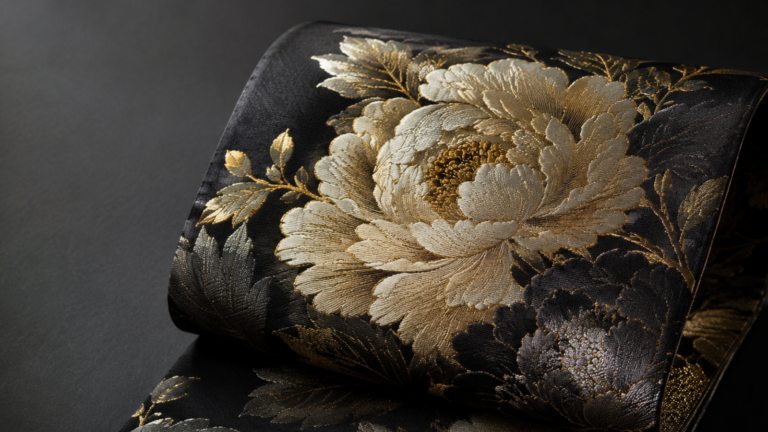
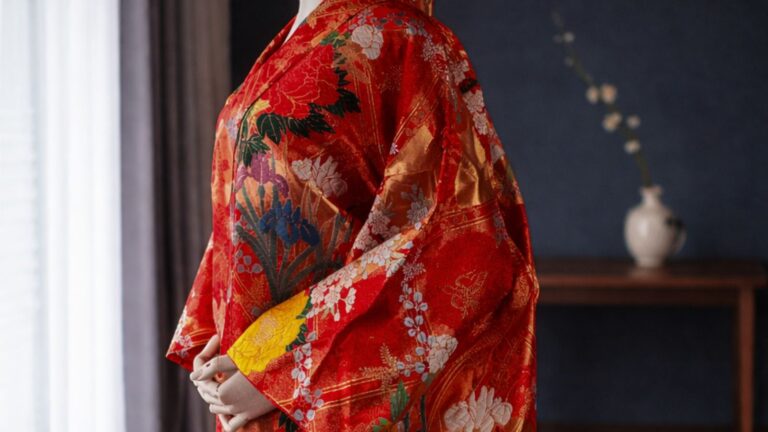
Among the many motifs found in Japanese kimono and obi, the peony holds a presence that feels both opulent and serene. Its layered petals unfold with a quiet confidence, neither modest nor overwhelming, but perfectly balanced between elegance and abundance.
In Japan, the peony is often called “the king of flowers.”
This title does not suggest dominance, but rather a natural dignity — a beauty that does not need to announce itself.
When woven into silk, the peony becomes more than a decorative element. It transforms into a symbol, carrying centuries of cultural memory. It speaks of prosperity, of refined taste, and of a life enriched not only by material wealth, but by an appreciation for beauty itself.
Origins: A Journey from Imperial China
The cultural story of the peony begins in ancient China, where it was cultivated in imperial gardens and admired by scholars, artists, and nobility. It was closely associated with wealth, honor, and high social status — a flower worthy of emperors.
In Chinese art, peonies were often depicted in full bloom, representing not only prosperity but also power and success. Their lush appearance made them an ideal symbol of abundance.
As cultural exchange flourished between China and Japan, particularly during the Nara and Heian periods, the peony motif was introduced to Japan along with many other artistic and philosophical influences.
Yet, as with many imported symbols, the Japanese interpretation of the peony evolved.
Where Chinese representations emphasized grandeur and status, Japanese aesthetics introduced a sense of softness and transience. The peony retained its association with wealth, but it also began to reflect a deeper sensitivity to the fleeting nature of beauty.
The Japanese Interpretation: Beauty and Impermanence
In Japan, the peony came to embody a dual meaning.
On one hand, it represents prosperity, good fortune, and elegance — qualities that align with its historical associations. On the other hand, it reflects a distinctly Japanese awareness of impermanence, often described through the concept of mono no aware.
The peony blooms boldly, its petals rich and full. Yet this beauty is short-lived. The flower fades quickly, reminding the viewer that even the most exquisite moments are temporary.
This contrast gives the peony its emotional depth.
It is not simply a celebration of beauty, but an acknowledgment of its passing.
Symbolism and Layered Meanings
The peony carries a range of symbolic meanings, often overlapping and reinforcing one another:
- Prosperity and material wealth
- Happiness and good fortune
- Feminine beauty and sensual elegance
- Nobility and refinement
- The transient nature of life
These meanings are not rigid. Instead, they create a fluid narrative that allows the motif to adapt to different contexts.
In formal garments, the peony may emphasize luxury and status.
In softer compositions, it may evoke romance or nostalgia.
The interpretation often depends on how the motif is presented — its scale, color, and surrounding elements.
Seasonal Associations
Although peonies are most commonly associated with late spring to early summer, their use in kimono is not strictly limited by season.
In traditional Japanese aesthetics, motifs can be used in two ways:
- Seasonal alignment — wearing motifs that match the current season
- Seasonal anticipation — choosing motifs that suggest the coming season
A peony worn slightly before its blooming season can create a sense of anticipation, while one worn at its peak season celebrates fullness and vitality.
This subtle play with time reflects a refined cultural sensibility — one that values suggestion over direct expression.
Peonies in Kimono and Obi Design
In kimono and obi, peonies are often depicted in various stages of bloom, each carrying its own nuance.
A fully open peony suggests abundance, confidence, and celebration.
A partially opened flower or a bud introduces a sense of potential — something yet to unfold.
Peonies are frequently combined with other auspicious motifs, creating layered meanings:
- Butterflies — transformation and joy
- Phoenixes — renewal, harmony, and rebirth
- Flowing water — continuity and the passage of time
- Arabesque vines (karakusa) — longevity and interconnectedness
The composition of these elements is never random. Each pairing adds depth, turning the textile into a visual narrative.
A Dialogue Between Past and Present
There is a subtle dialogue that occurs when traditional motifs are reimagined.
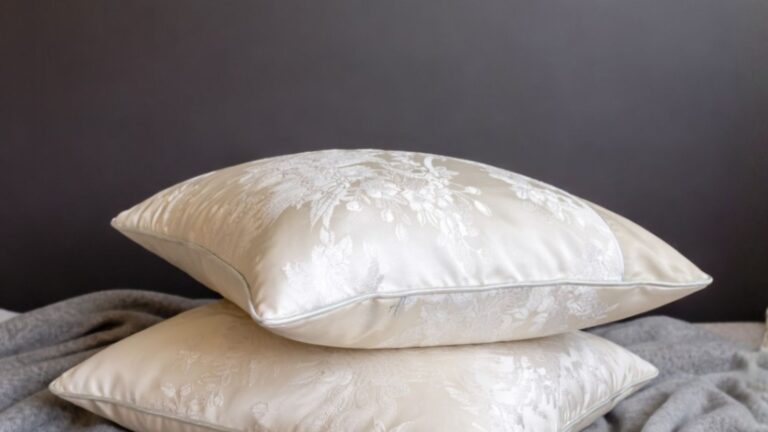
The peony, once worn in formal settings and ceremonial occasions, now finds itself integrated into contemporary spaces. This shift does not diminish its value. Instead, it expands its meaning.
It allows the motif to be experienced in new ways — not only as a symbol of status, but as a source of quiet inspiration.
Through this transformation, the peony continues to evolve, while remaining rooted in its cultural origins.
Western Perspectives and Interpretation
In Western contexts, peonies are also associated with romance, prosperity, and good fortune. They are often used in weddings and celebrations, symbolizing a happy and prosperous life.
This overlap in meaning creates a natural bridge between cultures.
However, the Japanese interpretation adds an additional layer — the awareness of impermanence. This nuance introduces a more introspective dimension, inviting the viewer to reflect not only on beauty, but on time itself.
Closing Reflection
The peony does not bloom forever.
Its beauty is full, generous, and immediate — yet fleeting.
Perhaps this is why it has remained a beloved motif for centuries. It captures a moment of perfection, while gently reminding us that such moments cannot be held.
To choose a peony is to embrace both richness and transience.
To appreciate beauty, knowing that it will change.
It is not simply a flower woven into silk.
It is a story — of prosperity, of grace, and of time passing quietly.