Pine
The Tree That Does Not Announce the Seasons
On matsu, and what it means to find beauty in a thing that simply refuses to change
Most motifs in Japanese textile design are about transformation. The cherry blossom falls. The chrysanthemum opens in the cold. The crane lifts into open sky. Even the peony belongs to a particular week of late spring.
The pine does none of this. It is the same in January as it is in August. Against the white of snow or the heat of summer, it holds its color — a deep, untroubled green — without announcement, without ceremony, without asking to be noticed.
This is its beauty, and its particular kind of difficulty. In a culture that has refined the appreciation of impermanence into an art form, the pine insists on permanence.
The word matsu carries within it a verb: to wait. The pine tree, in Japanese, is the tree that waits — specifically, for a god’s soul to descend from heaven.
In ancient Shinto belief, the pine was understood as a vessel — a living column between the earthly and the divine. Gods were thought to descend along its trunk, to rest within its branches. The tree’s stillness was not passive. It was the stillness of readiness. Of something that holds itself open, year after year, for a presence that may or may not come.
The pine belongs to the shochikubai — the Three Friends of Winter — alongside bamboo and plum. Each of the three endures the cold season in its own way. But of the three, the pine is the one that asks the least of winter. It does not bend dramatically. It does not bloom defiantly. It simply does not change.
Pine needles, when they fall, fall in pairs — two needles bound together at the base, inseparable. This observation became the basis for a secondary layer of meaning: fidelity, devoted companionship, love that does not separate even in falling.
Longevity and love, endurance and devotion — in the pine, these are not separate ideas. They are the same idea, seen from different angles.
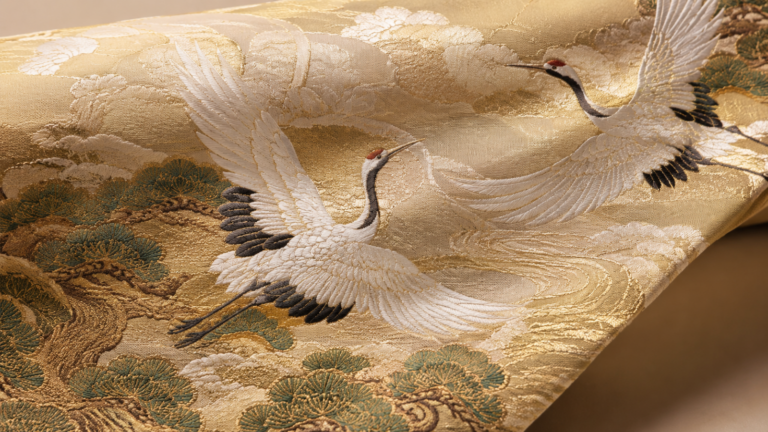
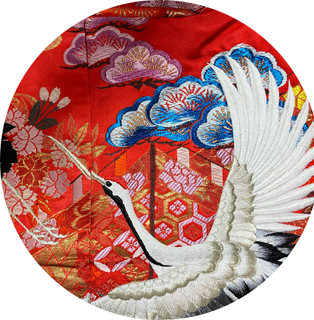
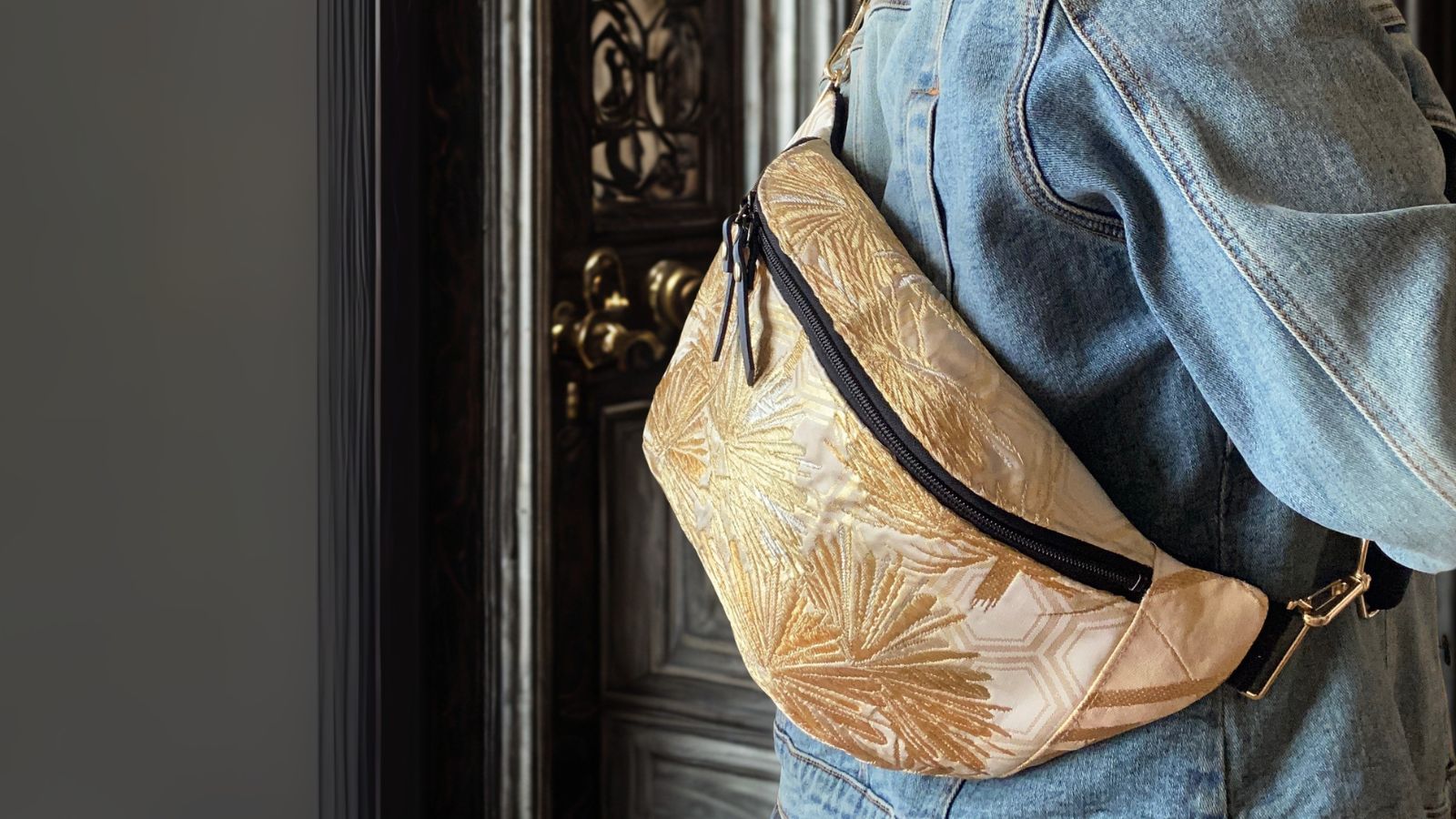
On textile, matsu appears in many registers. Sometimes as a sweeping, gnarled branch — aged, wind-shaped, unmistakably old — rendered in gold thread against a dark ground. Sometimes as young needles, fresh and fine, suggesting New Year and new beginnings. Sometimes reduced to the abstracted geometry of the matsuba pattern: pairs of needles arranged in a repeating field.
For those drawn to quiet luxury — to things made to last, worn across seasons, meaningful without display — the pine may be the most honest of all the kimono motifs. It does not promise transformation. It offers something rarer, in the end: the assurance of continuity. That some things, tended well, simply do not end.
The pine waits. And in waiting, it becomes the thing it was always waiting to be.
Matsu motifs appear across miyakorondo pieces — from gnarled branch compositions on formal obi to the delicate repeated matsuba pattern in quieter pieces. In each, the same quality: a green that does not ask permission to remain.