Senmen
A World Inside the Opening
On senmen, and what it means to carry a shape that contains everything — and keeps expanding
Every other motif in this series depicts something from the natural world — a bird, a flower, a tree, a geometric shape borrowed from a creature’s shell. The fan is different. It is an object made by human hands, and its presence on textile is a meditation not on nature, but on what people make, and what the things they make come to mean.
The folding fan was invented in Japan. The earliest examples date to the Heian period, fashioned from thin strips of hinoki cypress or bamboo, used first by court nobles and then by everyone. Closed, it is a narrow bundle, compressed and unassuming. Open, it expands outward in a perfect arc, each fold revealing more surface, more possibility.
The Japanese name for this shape is suehiro — “wide at the end.” And suehiro became, in time, another word for good fortune itself.
The logic is direct: a life that opens as it unfolds, that becomes larger and more capacious with each passing year — this is what the fan’s form suggests. Not a straight line. Not a circle returning to its beginning. An outward expansion, from a single point, toward a horizon that keeps receding. Prosperity, in the Japanese imagination, looks like this. It fans out. It does not contract.
The suehiro — a small formal fan of gold and silver paper — became an essential accessory of the most formal women’s dress. Tucked into the obi of a black tomesode at a wedding, never opened, never used for air: carried instead as an emblem. A woman at a celebration holding the shape of good fortune against her body, saying nothing about it, needing to say nothing.
There is also a history of the fan as protection. Women of rank carried fans in place of the small blade as a formal boundary, a visible declaration of the distance appropriate between them. In tea ceremony, the fan placed on the tatami mat before a guest serves this function still — a threshold, a mark of respect, a line that says: here is where I end, and where you begin.
A single object, then, that means expansion and boundary simultaneously. Opening outward and holding a space intact. These are not contradictions in Japanese aesthetics — they are complementary qualities, two aspects of the same poise.
What makes the senmen motif particularly rich on textile is what happens inside the fan’s arc. The shape becomes a frame — and within that frame, another world opens.
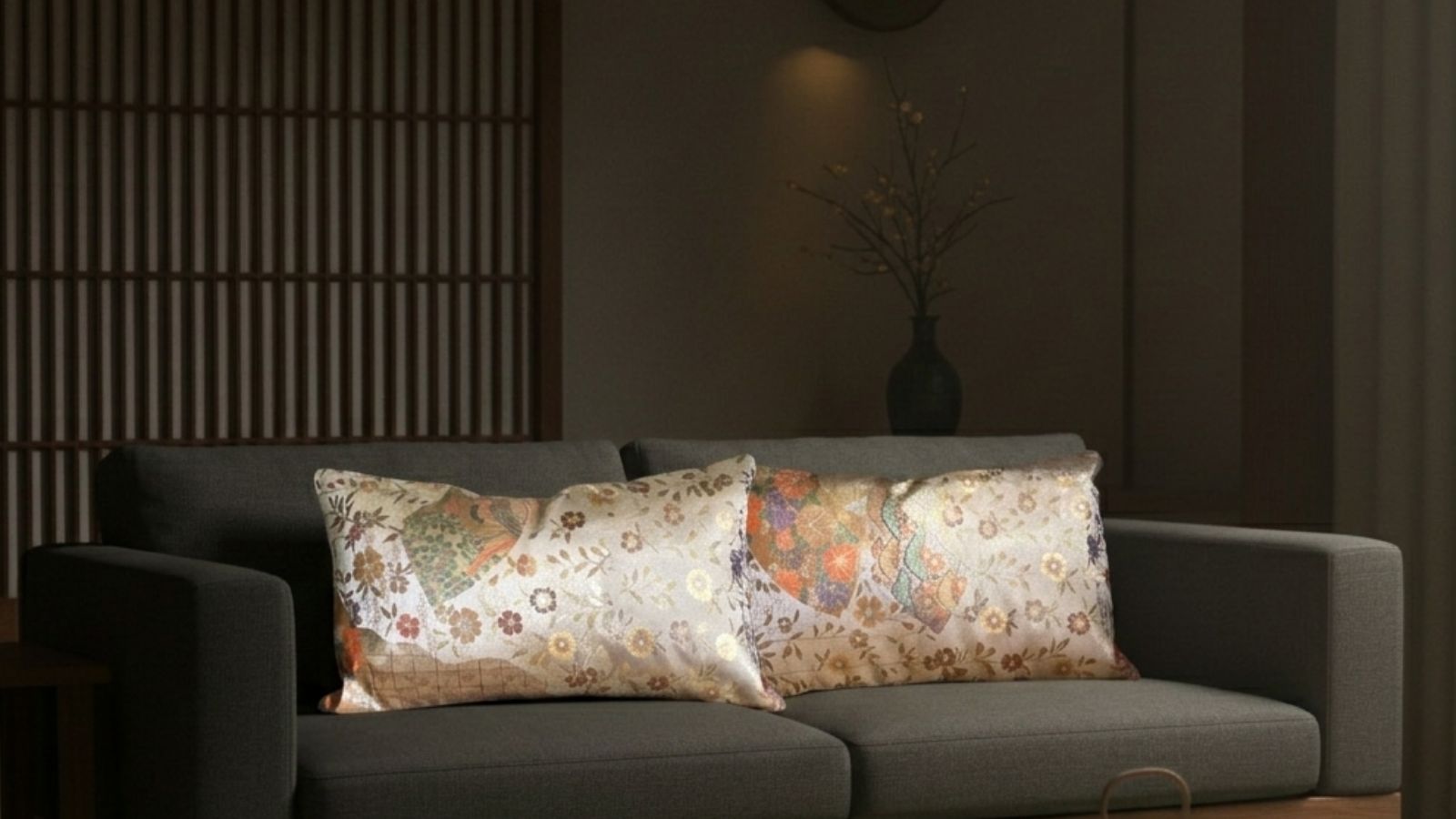
On formal obi and kimono, the fan is almost never depicted empty. Inside each arc, a separate composition unfolds: a spray of spring blossoms, a branch of autumn maple, a passage of flowing water, a landscape glimpsed in miniature. Multiple fans arranged across a textile surface create a kind of gallery — each one a small world, each world a different season or scene.
For a Western reader, the fan may initially seem the most decorative of the motifs in this series. But sit with it longer. It is the only motif here that is also a gesture — that exists in the body’s movement before it exists on cloth. To open a fan is to do something. To wear its image is to carry that doing with you, folded and still, ready.
A life that keeps opening. A boundary held with grace. A shape that contains worlds. This is what suehiro means, and what the senmen motif carries — on silk, on formal obi, in the quiet arc of a form that only ever moves in one direction: outward, and wider, toward whatever comes next.
Senmen motifs appear across miyakorondo obi pieces — sometimes as single large fans holding elaborate inner compositions, sometimes as scattered smaller arcs each containing a different season. In each, the same geometry: a point, an opening, a world held inside the expansion.